EN 16361 - Power-operated pedestrian doors - Performance characteristics - Pedestrian doors, other than swing doors, initially designed for power-operated installation
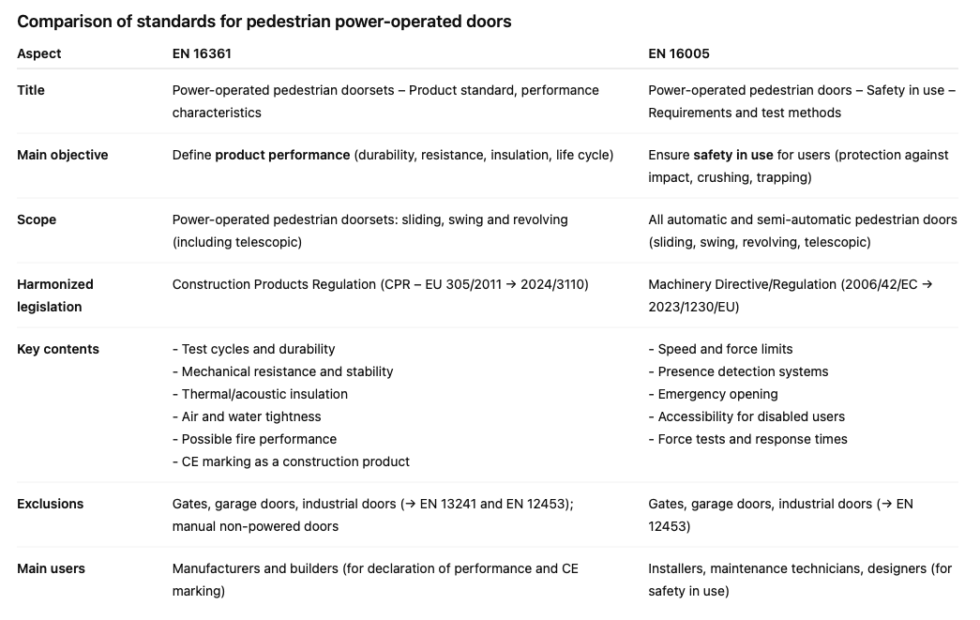
EN 16361 specifies performance requirements and product performance assessments (durability, mechanical resistance, fire safety, insulation, etc.).
Aim
The standard aims to:
- Define the minimum performance characteristics of motorised pedestrian doors;
- Ensure safe operation in relation to the various intended uses;
- Establish test and classification methods relating to strength, durability and additional performance.
Scope of Application
It applies to:
- Motorised sliding, swing and revolving pedestrian doors (including telescopic doors);
- Installations in public, commercial, residential, healthcare and transport buildings;
- Products intended for frequent and intensive use, with high safety and durability requirements.
It does not apply to:
- Motorised gates, garage doors and industrial doors (covered by EN 12453 and EN 13241);
- Non-motorised manual doors (regulated by other specific standards).
Main contents
- Durability and test cycles: minimum number of guaranteed opening/closing cycles;
- Mechanical strength and stability of leaves;
- Safety in use (in coordination with EN 16005);
- Additional performance: thermal and acoustic insulation, air and water resistance, fire performance (where applicable);
- CE marking requirements as a harmonised product standard in accordance with the Construction Products Regulation (EU) 305/2011 ->CPR 2024/3110.